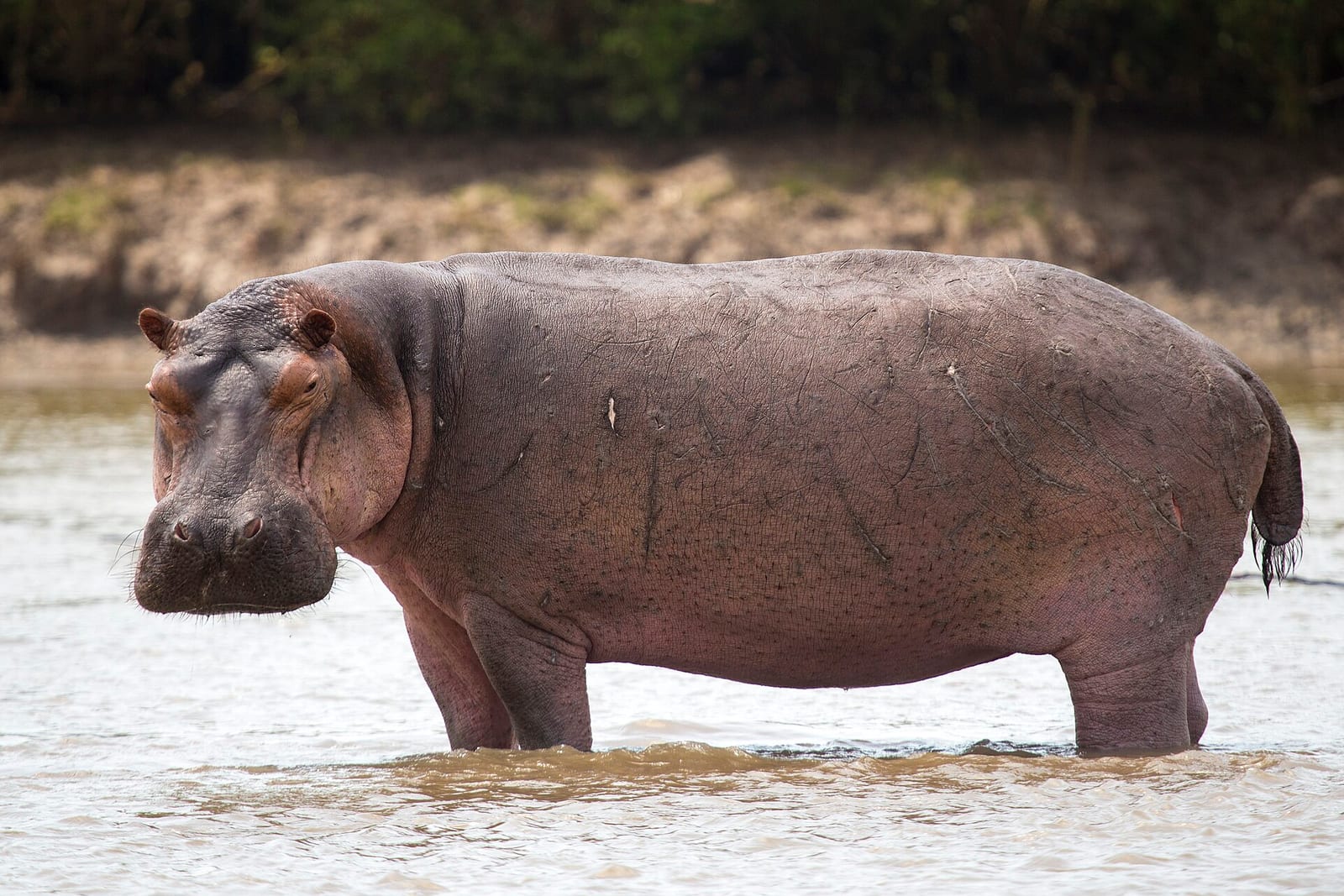
Every Mara River crossing plays out over an audience of hippos — grey backs rafted mid-river, ears flicking, the honking chuckle that is Africa’s water signature. Kenya’s rivers and lakes hold them in their thousands, and no sound settles a safari camp into evening like hippos grazing past the tents.
The comedy hides the continent’s most surprising statistics: hippos kill more people in Africa than any other large mammal, run faster than Olympic sprinters over short ground, and spend their nights kilometres from water mowing grass. Tsavo West’s Mzima Springs adds the rarest view of all — hippos walking the river bottom, watched through an underwater chamber.
Where to see hippopotamuss in Kenya
The Mara River’s pods are the classic scene; Mzima Springs offers the underwater chamber; Lake Naivasha boat trips (outside the parks) bring respectful close passes.
Masai Mara
The greatest wildlife arena on Earth
Tsavo West
Land of lava, springs and long views
Amboseli
Giants beneath Kilimanjaro
Nairobi NP
Lions with a skyline
Meru
Where Elsa walked free
Samburu
Wild north, different animals
Lake Nakuru
The rhino sanctuary on the pink lake
Best time: Year-round. Dry seasons crowd pods into shrinking pools — noisy, jostling theatre; dusk brings them ashore to graze.
Hippopotamus: frequently asked questions
Are hippos really that dangerous?
Statistically Africa’s deadliest large land mammal — not from malice but geometry: they panic when cut off from water and flatten whatever stands in the path. The rules are simple: never stand between a hippo and its river, and treat riverbanks seriously at night.
Can hippos swim?
Barely — they are too dense to float. What looks like swimming is controlled bottom-walking and porpoising, with adults surfacing to breathe every three to five minutes, automatically even while asleep.
Why do hippos yawn at each other?
It is a threat display, showing tusks that can bisect a crocodile. Bulls settle river hierarchies with gape contests before escalating to genuinely vicious fights — the scarred backs in every pod tell the history.