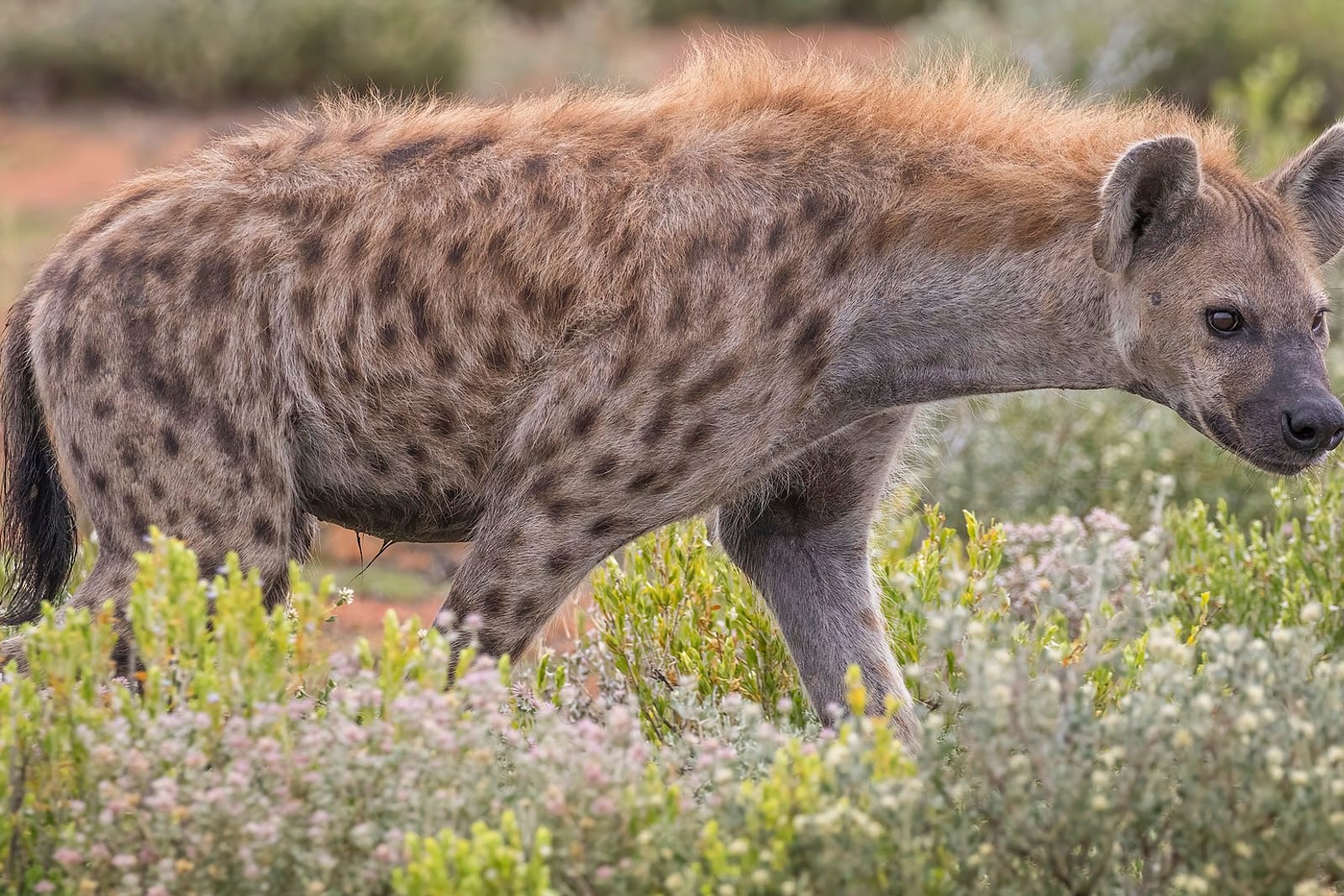
Forget everything the cartoons taught you. Spotted hyenas are the Mara’s most successful large carnivore: brilliant, social, matriarchal — every clan is ruled by females who outrank all males — and they hunt more of their own food than lions do, running down wildebeest in relentless night pursuits.
Their society is the savanna’s most complex: clans up to 80 strong with inherited rank, politics, and a vocabulary of whoops, giggles and groans that carries kilometres. The nighttime whooping chorus — rising, eerie, unforgettable — is the true soundtrack of a Mara camp after dark.
Where to see spotted hyenas in Kenya
Abundant in every savanna park; the Mara’s clans, studied for decades, provide den scenes with cubs — among safari’s most charming sights, whatever the reputation says.
Masai Mara
The greatest wildlife arena on Earth
Amboseli
Giants beneath Kilimanjaro
Tsavo East
Red elephants and infinite horizons
Nairobi NP
Lions with a skyline
Samburu
Wild north, different animals
Lake Nakuru
The rhino sanctuary on the pink lake
Best time: Year-round; dawn drives catch clans returning from night hunts, and migration season turns the Mara into hyena high summer.
Spotted Hyena: frequently asked questions
Are hyenas just scavengers?
No — that is lion propaganda written into old nature films. Studies in the Serengeti-Mara show spotted hyenas kill 60–90% of their own food, and lions steal from hyenas at least as often as the reverse. The giggle you hear is usually a subordinate being displaced at a kill.
Why are female hyenas in charge?
Evolution handed females size, aggression and rank inheritance — a cub’s status comes from its mother, and even the top-ranked male sits below the lowest-ranked female. It is one of the most extreme matriarchies among mammals.
What is that whooping sound at night?
Long-distance hyena contact calls — each animal’s whoop is individually recognisable to clan-mates kilometres away. A rising chorus can mean a hunt assembling; it is the Mara’s authentic night music.