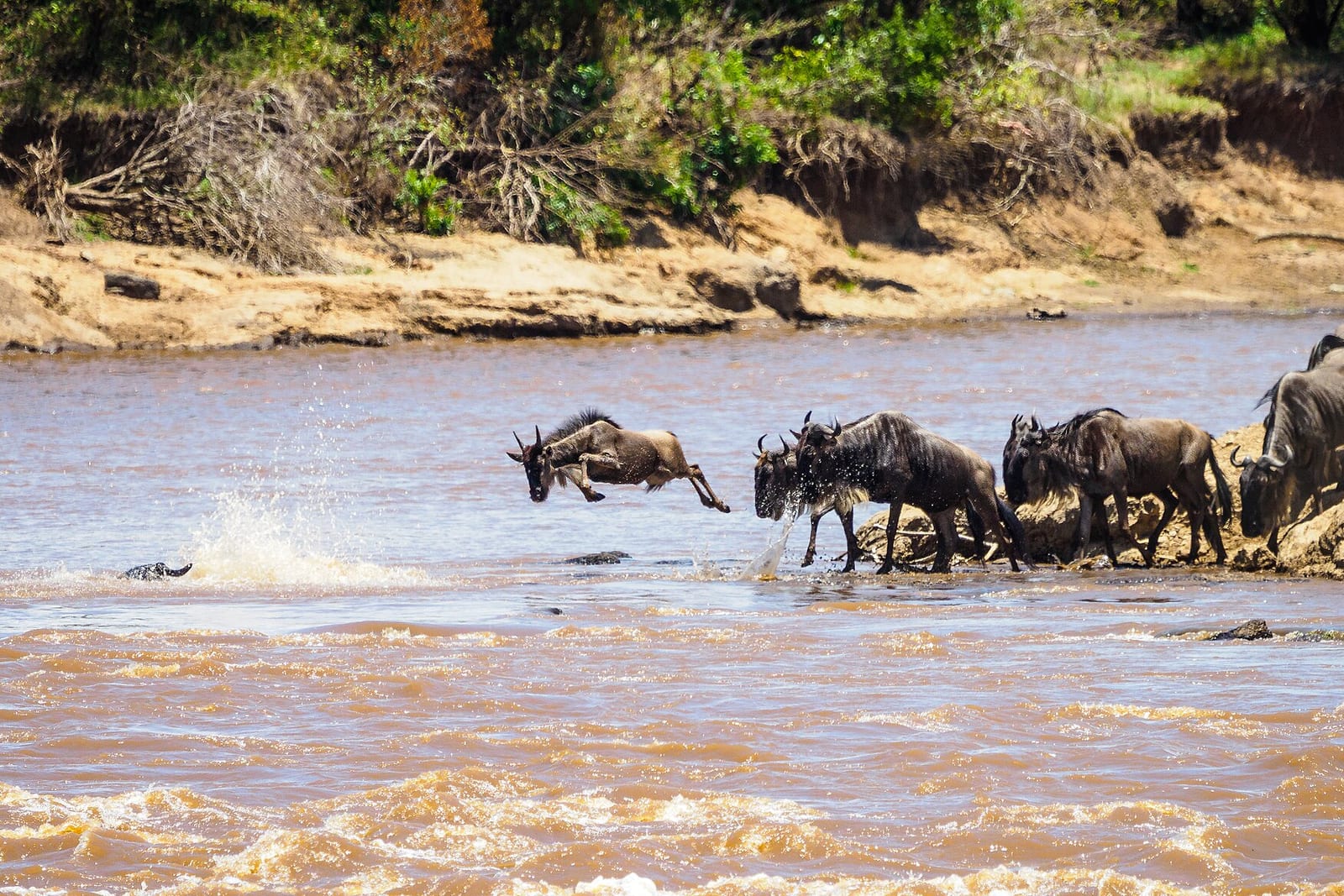
Individually, a wildebeest is a comic oddity — “designed by committee”, all shoulders, beard and mournful honk. Collectively, wildebeest are the greatest show on Earth: around 1.3–1.5 million of them power the Serengeti–Mara migration, an endless clockwise pilgrimage after rain-fresh grass that has run for millennia.
Kenya’s chapter is the climax. From about July the columns pour north into the Masai Mara, and at the Mara River the drama compresses: massed herds on the bank, the pressure building for hours, then the plunge — crocodiles rising, currents dragging, dust and spray and thunder. By November the survivors drift south again to calve. No wildlife event on the planet matches it.
Where to see wildebeests in Kenya
The migration is a Mara-only spectacle in Kenya (Jul–Oct, river crossings at the Mara and Talek rivers). Resident wildebeest live year-round in Amboseli and Nairobi NP.
Masai Mara
The greatest wildlife arena on Earth
Amboseli
Giants beneath Kilimanjaro
Nairobi NP
Lions with a skyline
Best time: Mid-July to October for the herds in the Mara; August–September is the statistical sweet spot for river crossings. Book the season a year ahead.
Wildebeest: frequently asked questions
When exactly do the wildebeest cross the Mara River?
Unpredictably — that is the truth behind every brochure. The herds are typically in the Mara July–October and crossings cluster mid-July to September, but each event depends on rain, grass and herd nerve. Give yourself three-plus days near the river and let the odds work.
Why do wildebeest cross crocodile-infested rivers at all?
Grass rules them: the herds track rainfall to fresh grazing, and the rivers lie across the route. Crossings are the toll the migration pays — thousands die, yet the grass gained keeps 1.5 million alive.
Is the Great Migration only in Kenya?
It is one ecosystem shared with Tanzania: the herds spend roughly August–October centred on the Mara and the rest of the circuit in the Serengeti, calving in its south each February. Kenya owns the river-crossing climax.
What is a wildebeest, actually?
A large antelope (also called gnu) of the open plains, built for perpetual motion — drab alone, magnificent by the hundred thousand. The name is Dutch for “wild beast”.